Independent Analysis
UK NFL Betting Odds: Data-Driven Markets and Live Lines
 Available in US
I placed my first NFL wager the same week Wembley hosted its second-ever regular season game, back when most UK punters could not tell a point spread from a goal handicap. Eight years on, the landscape barely resembles itself. The NFL counts 14.3 million fans in the United Kingdom (nearly one in five adults, per the league’s own research) and the betting markets around American football have swollen to match. In the 2025 season, legal sportsbooks in the United States alone handled a record $30 billion in NFL wagers, according to the American Gaming Association. That is not a niche any more. That is a global phenomenon, and UK punters sit squarely inside it.
Yet most of the content written for British bettors still reads like a promotional leaflet: sign up here, grab this bonus, here are five bookmakers we like. Very little of it treats you as someone capable of understanding how odds are priced, why lines move, or what the data actually says about your edge, or lack of one. This guide exists to fill that gap. I have spent the better part of a decade modelling NFL odds, identifying value, and watching UK coverage of American football grow from a curiosity into a serious market. Everything that follows comes from that experience and from publicly available data, not from a marketing department.
Whether you are converting American odds to fractional for the first time, or you already know what closing line value means and want to see how the 2025 UKGC reforms affect your approach, this pillar page is designed to give you a structured, data-driven foundation. Bookmark it, argue with it, use it as a starting point for deeper dives into spreads, moneylines, props and live betting. The NFL rewards preparation. So does betting on it.
Table of Contents
- UK Punter Essential NFL Betting Markets & Odds Comparison
- How NFL Betting Odds Work
- Core NFL Betting Markets at a Glance
- NFL Betting in the UK: Market Size and Fan Growth
- The NFL Season Calendar and When Odds Move
- Beyond the Basics: Advanced Metrics for Smarter Bets
- Responsible Gambling: Staying in Control
- Smarter Odds Start with Better Data
- Frequently Asked Questions
UK Punter Essential NFL Betting Markets & Odds Comparison
- NFL odds use three formats (fractional, decimal, and American) but all express the same underlying price and implied probability. Learning to read American odds removes a friction layer that slows your analysis.
- The UK has 14.3 million NFL fans and a betting market generating £7.8 billion in remote gambling yield, with 13.5 million active accounts monthly. The audience is large and growing.
- Point spreads, moneylines, and totals are the three core NFL markets. Each rewards a different analytical approach. Start with one and build outward.
- The 2025 UKGC reforms (a £100 million gambling levy, new stake limits, and financial risk checks) reshape the regulatory landscape for every bettor.
- Long-term profit comes from finding value (odds that understate true probability), not from picking winners. Track your closing line value, manage your bankroll, and bet within your means.
How NFL Betting Odds Work
The first time a UK punter opens an NFL odds page, the numbers can look like they belong on a different planet. Minus signs, plus signs, three-digit figures – it feels nothing like the fractional prices you see on Premier League markets. I remember staring at “-110” for a solid five minutes, convinced the bookmaker had broken its own website. It had not. I just did not speak the language yet.
NFL betting odds represent a bookmaker’s assessment of probability, wrapped inside a pricing format. Every set of odds, regardless of format, tells you two things: how much you stand to win relative to your stake, and how likely the bookmaker believes that outcome is. The global sports betting market sits at an estimated $112.26 billion in 2025, projected to reach $325.71 billion by 2035 according to Precedence Research. NFL is the single biggest driver of handle for the largest US operators, and UK books are increasingly building out their American football coverage to capture a share of that demand.

At their core, odds work identically across football, horse racing, tennis, or anything else. A bookmaker sets a price. That price implies a probability. The sum of implied probabilities across all outcomes exceeds 100%, and the excess is the bookmaker’s margin – the “overround” or “vig”. Understanding this mechanism is more important than memorising any conversion formula, because it is the foundation of every profitable decision you will ever make in this market.
Overround: the built-in margin a bookmaker adds to odds so that the implied probabilities of all outcomes in a market sum to more than 100%. Also known as the vig, juice, or margin.
The practical implication for you is straightforward: odds are not predictions. They are prices. A sportsbook’s point spread line does not tell you who will win – it tells you where the money has balanced and where the bookmaker feels comfortable taking risk. Grasping that distinction early saves you from the most expensive mistake in NFL betting, which is treating odds as gospel rather than as a starting point for your own analysis.
What follows in this section is a breakdown of the three odds formats you will encounter and a walkthrough of implied probability – the single most useful concept for any punter who wants to move beyond gut-feel wagering.
Fractional, Decimal and American: Reading the Numbers
Three formats, one price. That is the mantra I repeat to anyone who panics at an American odds screen. The number looks different, but the underlying value (how much profit you collect per unit staked) is identical. The format is just a dialect.
UK Format: Fractional
The default on most British sportsbooks. Expressed as a fraction: 5/1, 11/10, 2/7. The numerator is your profit; the denominator is your stake. A winning bet at 5/1 returns your original stake plus five times that stake in profit.
US Format: American
The standard in American sportsbooks. Positive numbers (+200) show profit on a 100-unit stake. Negative numbers (-150) show how much you must stake to win 100 units of profit. The favourite carries the minus sign; the underdog carries the plus.
Decimal odds, common across continental Europe and increasingly available on UK platforms, fold the stake into the return. Odds of 3.00 mean a total return of three units per unit staked (two units of profit plus your original one). This format makes quick comparisons easy, which is why many experienced bettors switch to it regardless of where they are based.
Same price, three formats
Suppose a bookmaker prices a team as a moderate underdog. In fractional: 2/1. In decimal: 3.00. In American: +200. A 10-unit stake returns 30 units total – 20 profit plus your 10 back. The format changes; the maths does not.
Most UK sportsbooks let you toggle between formats in your account settings, and I would recommend doing exactly that when you encounter NFL-specific content. American odds are the native language of NFL analysis. Every piece of sharp commentary, every line movement alert, every podcast discussion quotes American odds. Learning to read them, even if you prefer to bet in fractional, removes a layer of friction that slows down your analysis.
The conversion itself is mechanical. For positive American odds, divide by 100 to get the fractional numerator over 1 (so +150 becomes 3/2). For negative American odds, place 100 over the absolute value (so -200 becomes 1/2). These formulas become second nature after a few weeks, but the real payoff is not speed – it is fluency. When you can read American odds without mentally translating, you start spotting line moves faster and reacting to market shifts before casual punters even notice something has changed.
Implied Probability and What the Odds Actually Tell You
Every set of odds contains a hidden percentage – the bookmaker’s implied probability for that outcome. Extracting it is the single most valuable habit I have developed in eight years of NFL odds modelling, because it transforms odds from abstract numbers into statements you can agree or disagree with.
The formula is simple. For decimal odds, divide 1 by the decimal price. Odds of 2.50 imply a 40% chance (1 / 2.50 = 0.40). For fractional odds, divide the denominator by the sum of numerator and denominator. Odds of 6/4 imply a 40% chance (4 / (6+4) = 0.40). For negative American odds, divide the absolute value by itself plus 100. For positive American odds, divide 100 by the number plus 100.
Implied probability in practice
A bookmaker sets the favourite at 4/7 fractional (1.57 decimal, -175 American). Implied probability: 7 / (4+7) = 63.6%. The underdog sits at 6/4 fractional (2.50 decimal, +150 American). Implied probability: 4 / (6+4) = 40.0%. Those two figures sum to 103.6% – the extra 3.6 percentage points are the overround.
That margin, the overround, is the gap between the market’s implied probabilities and reality. A perfectly fair market would sum to 100%. In practice, NFL game lines at major UK sportsbooks typically carry overrounds between 3% and 6%, depending on the market and the time before kickoff. Smaller markets like individual player props and drive-level bets tend to carry wider margins, sometimes exceeding 8%.
Why does this matter? Because if you believe a team has a genuine 50% chance of winning and the implied probability from the odds is only 45%, the difference represents potential value. Your assessment says the price is too high relative to the true likelihood. That gap is where long-term profit lives – not in picking winners, but in finding prices that understate the real probability. This is the foundation of value betting, and it applies to every NFL market from season-long futures to in-play quarter totals.
Core NFL Betting Markets at a Glance
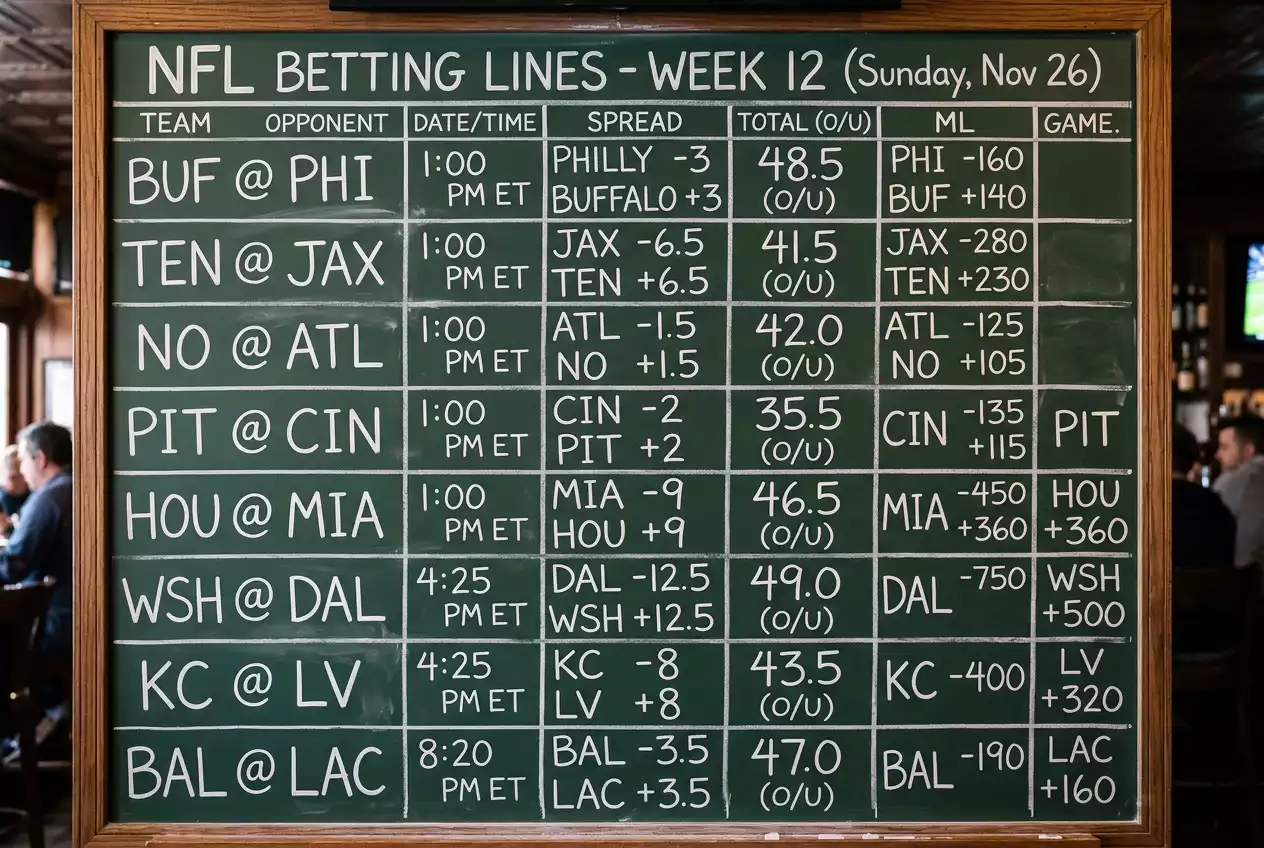
Walk into any UK sportsbook’s NFL section on a Sunday afternoon (or, more realistically, open the app at half past midnight) and you will find three markets sitting at the top of every game card. Point spread, moneyline, total. They account for the vast majority of handle across every major operator, and NFL generates more wagering volume than any other American league despite having far fewer games than the NBA or MLB, according to industry reporting from major US sportsbooks.
Point Spread
The handicap market. One team gives points; the other receives them. The most popular single NFL market by handle.
Moneyline
Pick the outright winner. No handicap. The simplest NFL wager.
Totals
Bet on the combined final score going over or under a set line. Also known as the over/under.
Each of these markets carries distinct characteristics, with different edges, different traps, and different optimal strategies. What follows is an overview of each. For deeper tactical breakdowns, I have written dedicated guides that go well beyond the summaries here.
Point Spreads
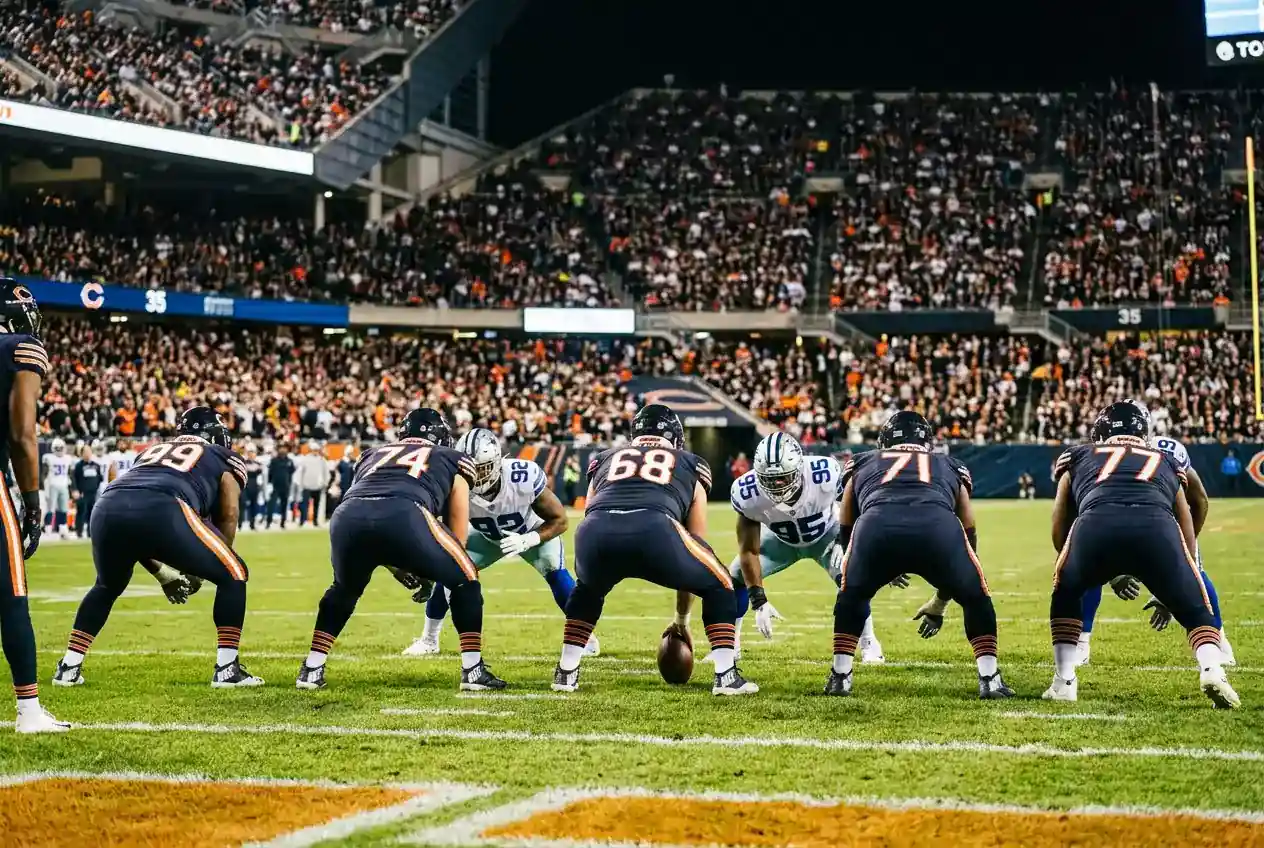
The point spread (known as the “handicap” in UK betting terminology) levels the playing field by assigning a points advantage to the underdog. If a team is favoured by 7 points, it must win by more than 7 for a spread bet on the favourite to pay out. If it wins by exactly 7, the result is a push and stakes are returned.
Spread betting is the backbone of NFL wagering. It is where sharp bettors concentrate their action, where line movements reveal the most information, and where the interplay between key numbers – particularly 3 and 7, the most common NFL winning margins – creates strategic opportunities that do not exist in other sports. A half-point difference between 6.5 and 7 can materially change the expected value of a spread bet, which is why experienced punters obsess over these distinctions.
UK sportsbooks typically display NFL spreads in fractional odds alongside the handicap line. You might see a favourite listed at “-6.5 (10/11)” and the underdog at “+6.5 (10/11)”. The 10/11 price on both sides is roughly equivalent to the standard American “-110” vig. For a detailed breakdown of handicap mechanics, key numbers, and ATS analysis, the point spread betting guide covers it all.
Moneylines
A moneyline bet strips away the handicap entirely. You pick the team you think will win the game outright. No points given, no points received. The odds adjust to reflect each team’s perceived probability of winning, so heavy favourites carry short prices while underdogs offer larger returns.
Moneyline markets are often the first port of call for UK punters coming from football, where “match result” betting follows the same logic. The critical difference in the NFL is that draws are extraordinarily rare. Regular season games go to overtime if tied, and overtime rules make ties almost nonexistent. This means moneyline markets are essentially two-way, which simplifies the maths but concentrates the vig across fewer outcomes.
Where moneyline betting gets interesting is on underdogs. A team that you expect to cover a 3-point spread but perhaps not win outright presents a different proposition on the moneyline versus the spread. Knowing when to take the spread and when to back the underdog on the moneyline is a skill that separates casual punters from systematic ones. The moneyline explained guide walks through those scenarios in detail.
Totals (Over/Under)
A totals bet (the “over/under”) sets a line for the combined final score of both teams. You bet on whether the actual combined score will finish over or under that number. A typical NFL game total sits somewhere between 40 and 52 points, though the number varies significantly depending on the teams, venue, and weather conditions.
Totals appeal to punters who want to bet on the nature of a game rather than its winner. Is this going to be a defensive grind or a shootout? That question involves a different analytical toolkit: pace of play, offensive efficiency, defensive pressure rates, and external factors like wind and precipitation that have a measurable effect on scoring. Dome games between high-powered offences regularly see totals above 50; outdoor December games in the upper Midwest can dip below 40.
For UK punters, totals offer a useful entry point into NFL betting because they do not require deep knowledge of individual team strength. If you can assess whether a game is likely to be high-scoring or low-scoring based on a few key indicators, you have the basis for a totals bet. I consider them one of the most underrated markets in the NFL, especially during the late-season weeks when weather becomes a dominant factor. And once a game kicks off, totals take on an entirely new dimension – in-play NFL markets let you bet adjusted totals as the score develops, creating opportunities that pre-match markets simply cannot offer.
Those three markets form the architecture of NFL betting. But the market around them, particularly in the UK, has its own shape, its own data, and its own regulatory reality.
NFL Betting in the UK: Market Size and Fan Growth
A colleague of mine who covers the Premier League betting market once asked me why I bother with the NFL – “it is a niche sport for night owls,” he said. I showed him the numbers. He stopped asking.
14.3 million
NFL fans in the UK, nearly one in five adults, per NFL official research.
4 million
Of those fans classified as “avid”: actively following teams, watching games, engaging weekly.
3%
The UK’s share of global NFL search traffic, per Hyperset Group data.
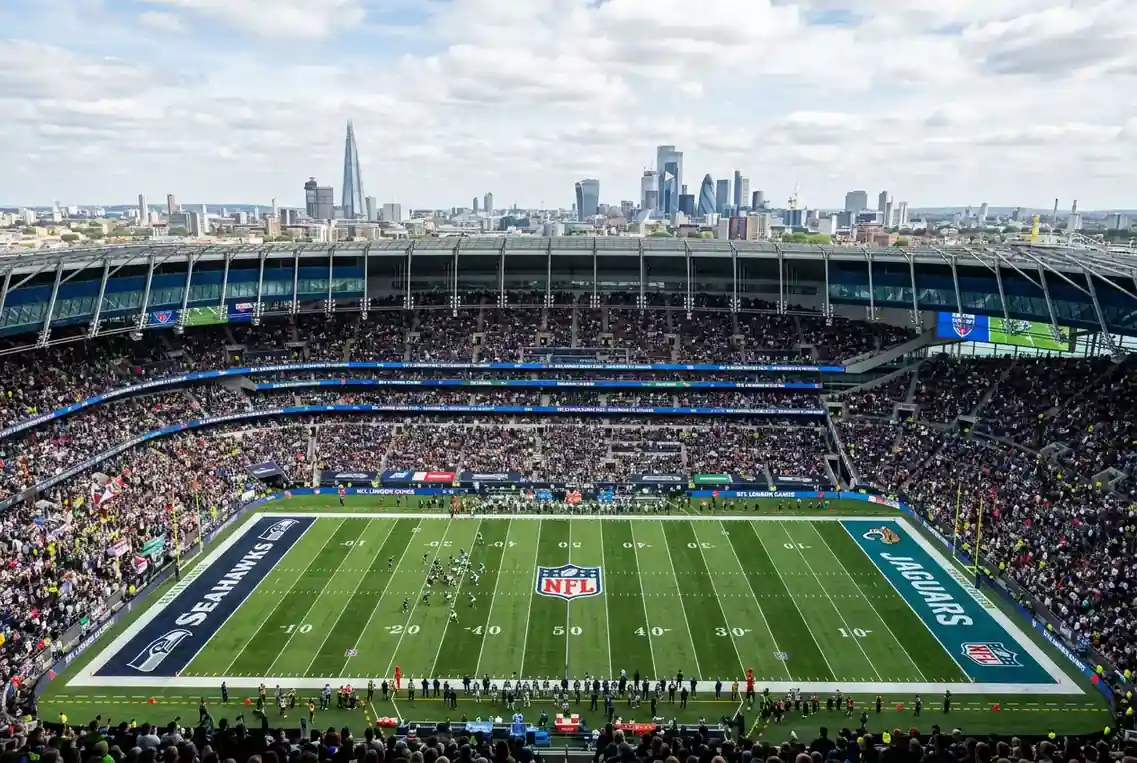
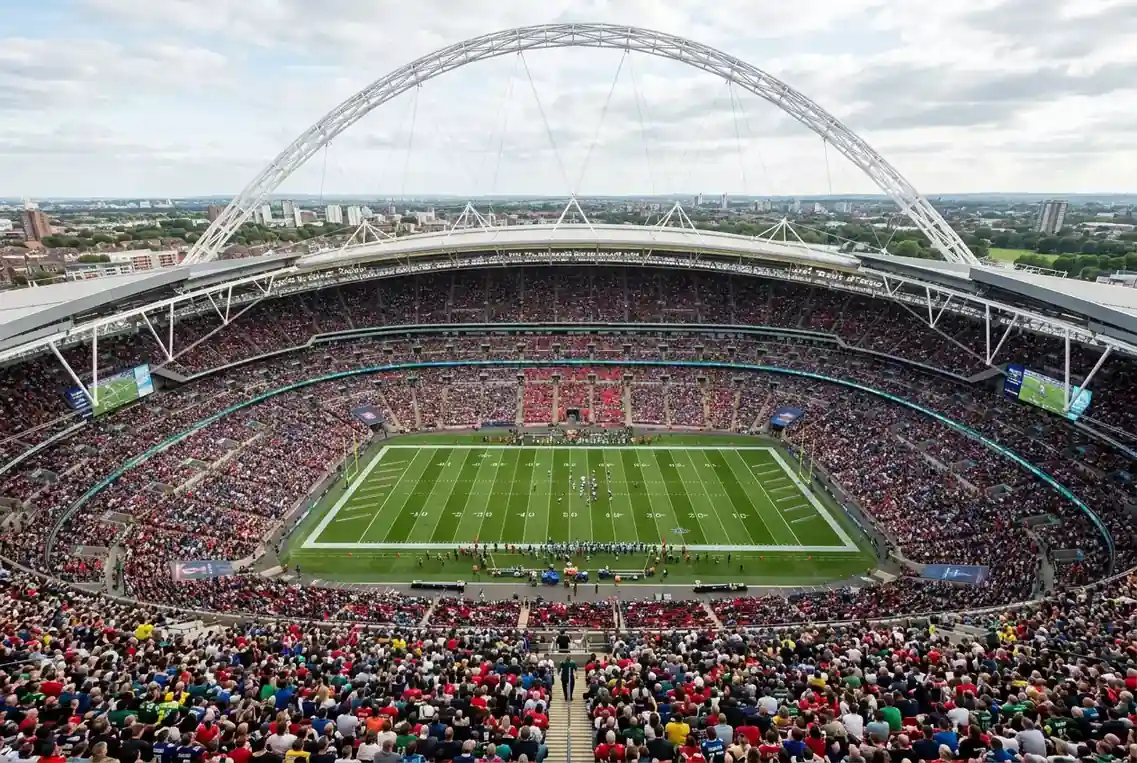
The UK is not just a secondary NFL market. It is the league’s most developed international beachhead, and the infrastructure reflects it. Since 2007, more than 39 regular season games have been played on British soil. The 2024 season set an attendance record of 86,651 at Wembley, per Sky Sports reporting. In 2025, the league staged a record seven international games, three of them in London, drawing more than six million TV and online viewers according to London Loves Business. Roger Goodell told CNBC that international markets are “very, very attractive” and that the league has solid coverage overseas – and the 2026 schedule backs that up, with three London fixtures planned alongside games in Munich, Mexico City, Melbourne, and Paris.
For the UK betting industry, NFL fan growth translates directly into market opportunity. The UK Gambling Commission reported total remote gambling gross gaming yield of £7.8 billion for the twelve months ending March 2025, a 13.1% year-on-year increase. Across the sector, there are 13.5 million active online gambling accounts per month, according to the Commission’s market overview for Q4 2024/25. NFL-specific handle data for the UK is not published the way it is in the United States, but the trajectory is clear: more fans means more bettors, more bettors means deeper markets, and deeper markets mean better odds for those of us who do the analytical work.
The Kansas City Chiefs are the most searched NFL team in the UK, capturing 9.5% of all team-specific queries (roughly 50,000 searches per month, per Hyperset Group analysis). The demographic breakdown of UK NFL fans skews 73% male, with the largest age group being 30 to 50 year-olds at 39%, according to YouGov Profiles.
What makes this market especially interesting from a betting perspective is the time-zone dynamic. Most NFL games kick off between 6pm and 1.20am UK time. That late-night window filters out casual punters and creates a slightly sharper, more engaged betting population. If you are awake at midnight watching a West Coast game, you are probably paying attention – and that changes the character of the market compared to a 3pm Saturday Premier League fixture where everyone and their dog has an opinion.
UKGC Oversight and the 2025 Reforms
The UK Gambling Commission does not just issue licences and disappear. It actively shapes how, when, and how much you can bet. The year 2025 brought the most significant regulatory overhaul in years.
From April 2025, operators face a mandatory gambling levy of £100 million per year, funding research, prevention, and treatment for problem gambling. UK Government ministers stated in the House of Lords debate that they are “investing £100 million of public money to tackle gambling harm” through this levy, with commissioning decisions made by statutory bodies. This is not a voluntary contribution. It is a legal obligation that changes the economics of every sportsbook operating in the UK.
Alongside the levy, the government introduced online stake limits: £5 per spin for players aged 25 and over, and £2 per spin for those aged 18 to 24, effective from April 2025. These limits currently apply to online slots rather than sports betting, but the regulatory direction is clear. Ministers in the House of Lords described the approach as designed to “target those most at risk of harm while ensuring that the impact on operators is proportionate”. Financial risk checks for active bettors are also part of the reform package, requiring operators to verify affordability before allowing sustained high-volume wagering.
For NFL bettors, the practical effects are indirect but real. The levy increases operator costs, which can trickle down into margins, promotions, and the depth of markets offered. The financial checks may affect high-volume punters who place large numbers of NFL wagers across a season. And the overall regulatory posture (tighter, more data-driven, more interventionist) means the UK betting environment is becoming more structured, not less. Knowing what separates a well-regulated NFL sportsbook in the UK from a mediocre one has never mattered more. A statistic from the House of Lords Gambling Industry Committee puts it starkly: 60% of UK bookmaker profits come from just 5% of customers, many of whom are problem gamblers or at risk. The reforms aim to change that ratio.
The NFL Season Calendar and When Odds Move
I used to think of the NFL calendar as “September to February, with a draft in April.” That was before I started tracking how odds behave at each phase. The truth is that the NFL betting calendar runs year-round, and each phase has its own rhythm, its own information dynamics, and its own opportunities.
The NFL season breaks into distinct phases, each with different betting implications. Preseason games (August) feature high roster turnover and limited starter playing time – markets are soft and volatile. The 18-week regular season (September through early January) is where the bulk of betting volume concentrates and where data accumulates. Playoffs (January through February) compress into single-elimination stakes with sharper lines and narrower margins. And then there is the offseason – draft, free agency, schedule release – when futures markets recalibrate.
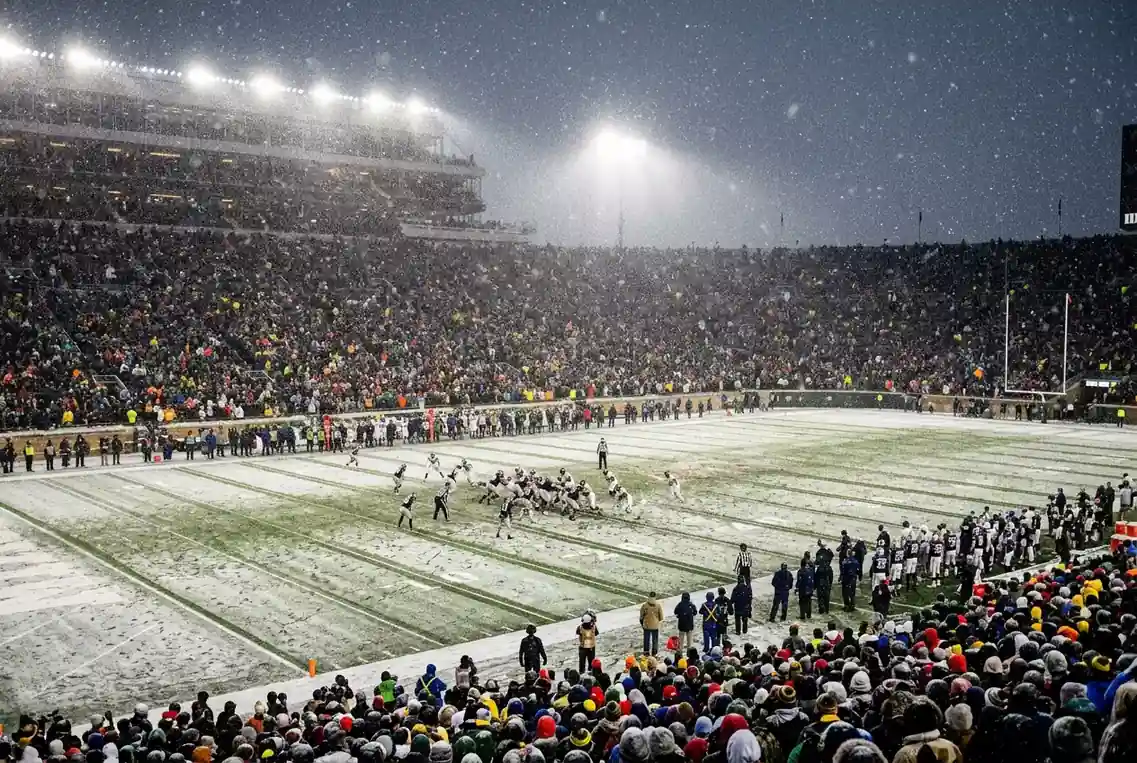
The timing of your bet matters as much as the bet itself. Lines typically open early in the week (often on Sunday night for the following week’s games) and move as money arrives, injury reports update, and sharp bettors stake their positions. In my experience, the biggest line movements happen between Tuesday and Thursday, when injury designations become clearer and the public money starts flowing. By Friday, lines have often settled – though weather forecasts for Sunday games can trigger late moves, particularly on totals.
For UK punters, the 2026 international schedule adds another layer. Three London games are planned, at Tottenham Hotspur Stadium and Wembley, alongside fixtures in Munich, Mexico City, Melbourne, and Paris. Roger Goodell’s stated goal is 16 international games per season, which would see every franchise playing one game abroad. That expansion creates unique betting dynamics around travel fatigue, neutral-venue crowds, and the unfamiliarity of non-standard playing environments. If you are interested in those edges specifically, keep an eye on London Games odds as the schedule firms up.
The broader point is structural. NFL betting is not a sprint – it is an 18-week marathon with a postseason bonus round and a summer warm-up. The punters who do best are the ones who understand where they are in the calendar and adjust their approach accordingly. Early-season lines are set with less data; late-season lines are set with more. Playoff lines are set in a media environment so saturated with narrative that public money often pushes prices away from fair value. Each phase rewards a different kind of discipline.
Beyond the Basics: Advanced Metrics for Smarter Bets
Here is a confession: for my first two years of NFL betting, I used box-score stats (passing yards, rushing yards, turnovers) and wondered why my results were mediocre. The day I discovered Expected Points Added changed everything. Not because it is some magic formula, but because it forced me to think about football the way bookmakers think about it: in terms of value generated per play, adjusted for context.
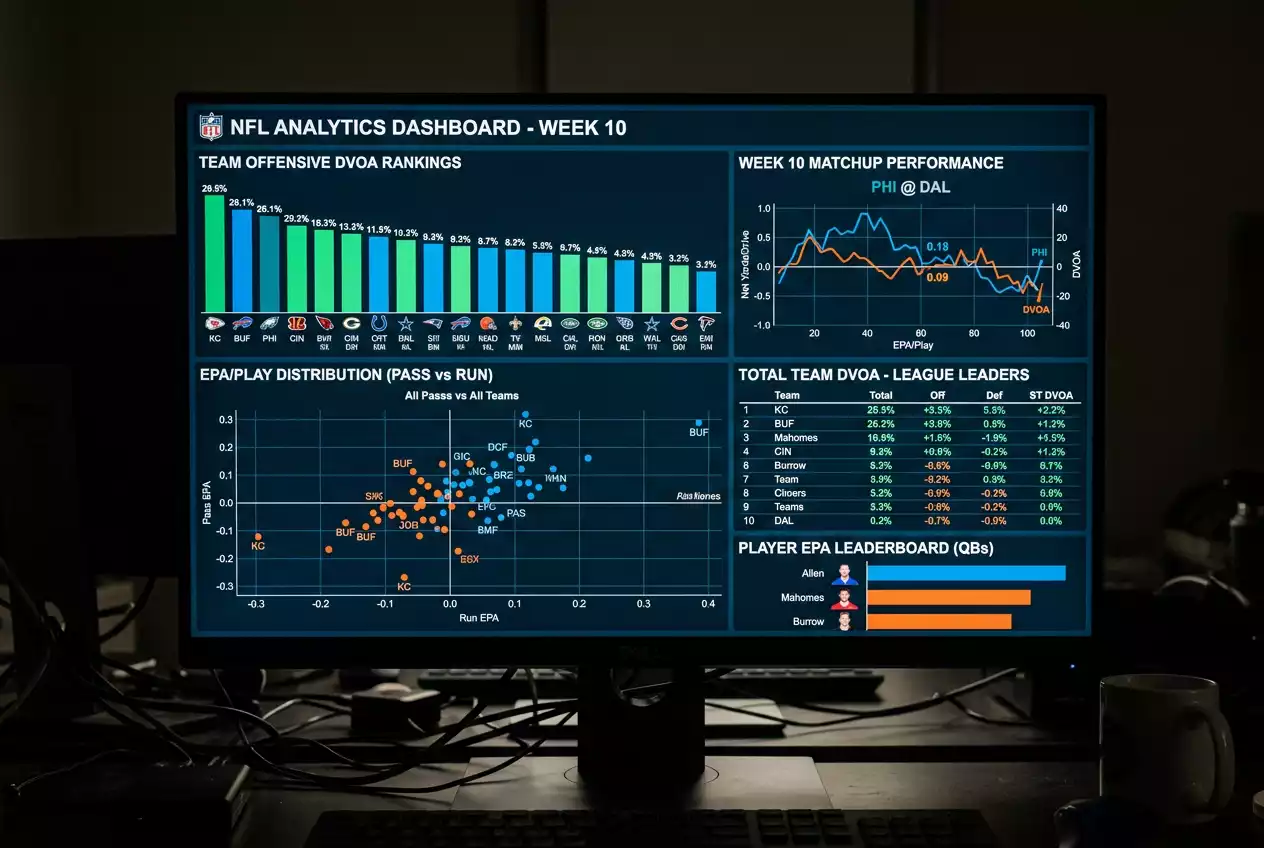
Advanced NFL analytics (EPA, or Expected Points Added; DVOA, or Defence-adjusted Value Over Average; and ATS, or Against The Spread records) exist because traditional stats lie. A quarterback who throws for 300 yards in a blowout loss is not comparable to one who throws for 220 in a tight win. Advanced metrics strip away context inflation and measure what actually matters: how much each play increased or decreased a team’s expected score.
EPA measures the change in expected points on each play. A 7-yard run on third-and-6 from midfield is far more valuable than a 7-yard run on first-and-10 from your own 20. Traditional stats treat them identically; EPA does not. DVOA takes this further by adjusting for opponent quality and game situation, producing a composite measure of offensive and defensive efficiency that is significantly more predictive than win-loss records for betting purposes.
ATS record: a team’s performance Against The Spread, measuring how often it covers the point spread rather than simply wins or loses. A team can have a losing record but a profitable ATS record if it consistently outperforms expectations.
I am not going to pretend that every UK punter needs to build EPA models from play-by-play data. But I will say this: understanding that these metrics exist, what they measure, and where to find them puts you ahead of anyone still relying on “Team X has won five in a row, so they must be good.” Five-game winning streaks tell you what happened. EPA and DVOA tell you how it happened and whether it is likely to continue. That distinction is worth real money over a full season.
For punters who want to go deeper, I have written a dedicated breakdown of how to apply EPA, DVOA, and ATS trends to real betting decisions – it is designed for people who are comfortable with the basics and ready to add a data layer to their process.
Value Betting in Brief
Value betting is the simplest profitable concept in all of sports wagering, and also the hardest to execute consistently. The idea: bet only when the odds offered by a bookmaker imply a lower probability than your own assessment of the true probability. That is it. No tricks, no systems, no “guaranteed winners.” Just a disciplined commitment to finding mispriced odds.
A value scenario
Suppose you model an underdog’s genuine win probability at 42%. The bookmaker’s odds imply only a 35% chance. The difference – 7 percentage points – represents value. Even if the underdog loses this particular game, repeatedly betting into that kind of gap produces profit over a large enough sample, because you are paying less for a probability than it is worth.
The benchmark most professional bettors use to assess whether they are finding value is closing line value, or CLV. The closing line is the final odds offered at kickoff, after all information has been absorbed by the market. If you consistently bet at prices better than the closing line, you are capturing value – regardless of whether any individual bet wins. CLV is the clearest long-term predictor of betting profitability, and it is something I track obsessively across every NFL season.
Finding value requires two things: your own probability estimate for an outcome (informed by data, not gut feel) and access to competitive odds across multiple sportsbooks. In the UK, where several UKGC-licensed operators carry NFL markets, comparing lines is straightforward. The punter who checks three or four prices before placing a bet will, over the course of a season, accumulate a meaningful edge over the punter who always bets with the same operator.
Responsible Gambling: Staying in Control
I have seen sharp bettors blow through a season’s worth of edge in a single bad week – not because their analysis failed, but because their discipline did. The most data-driven approach in the world means nothing if you chase losses, oversize your stakes, or bet impaired at 2am because a late game went sideways. Responsible gambling is not a regulatory afterthought; it is a prerequisite for sustained performance.

The Gambling Survey for Great Britain, published in its Wave 3 report covering July to October 2025, found that 48% of UK adults participated in some form of gambling in the preceding four weeks. Excluding the National Lottery, that figure drops to 27%. Among those, 10% placed sports bets online or through an app within the same period, per the Wave 2 report from April to July 2025. These are not fringe behaviours – they are mainstream activities, and the regulatory framework exists to ensure they remain manageable.
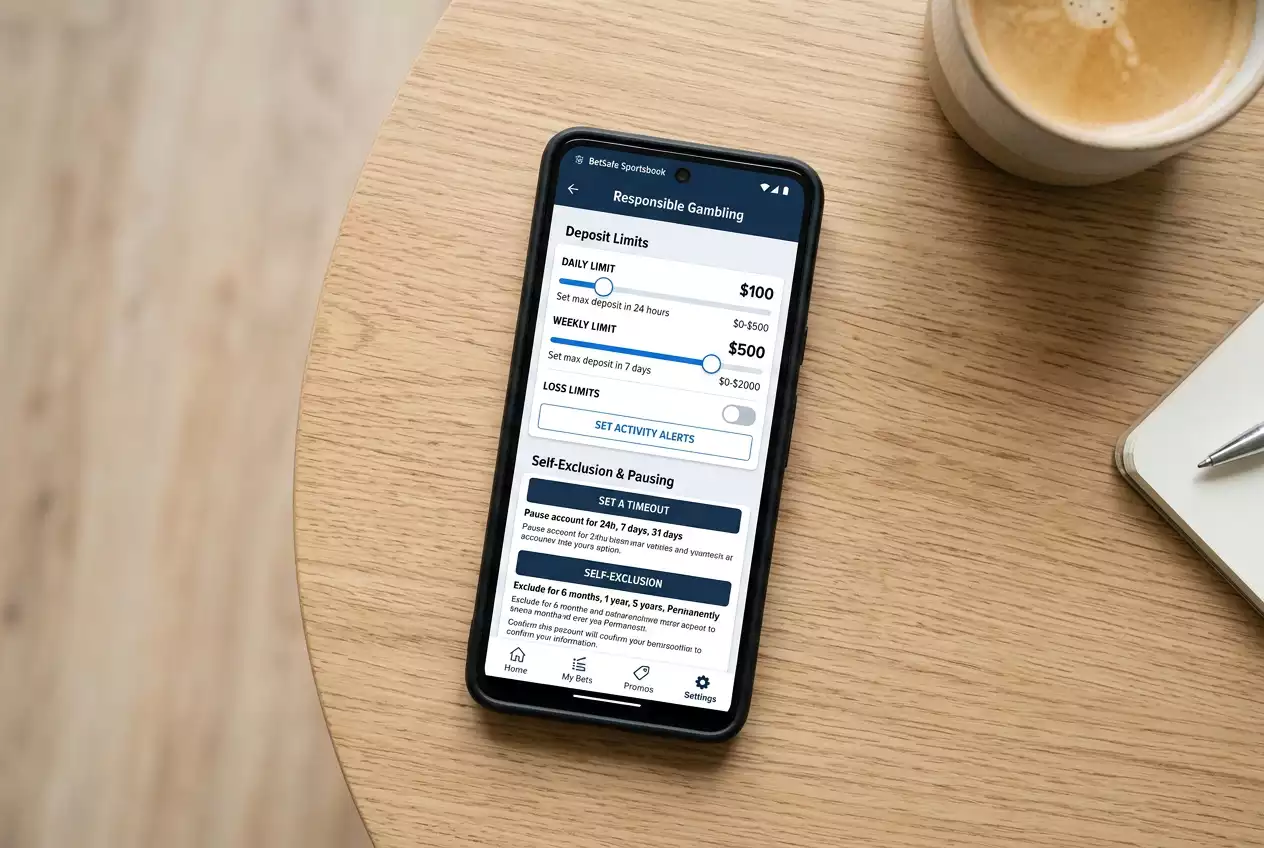
The tools available to UK bettors are, frankly, among the best in the world. GAMSTOP provides multi-operator self-exclusion, allowing you to block yourself from all UKGC-licensed gambling sites in a single action. Individual operators offer deposit limits, loss limits, time-outs, and reality checks that interrupt your session after a set period. The UK Government minister behind the 2025 gambling levy described the investment as directed toward research, prevention, and treatment – statutory bodies making commissioning decisions on how to tackle gambling harm.
Before you place any NFL bet
- Set a season-long bankroll that you can afford to lose entirely without affecting your daily life
- Establish a maximum stake per bet – 1% to 3% of your total bankroll is a common benchmark
- Review your deposit limits on every sportsbook you use and set them to match your bankroll plan
- Never increase stakes to recover losses from a previous bet or a previous week
- Track your bets in a spreadsheet or app – if you do not know your actual return, you cannot assess your process
- If you find yourself betting impulsively, take a break: use the time-out feature on your sportsbook account
I want to be direct about something. The economics of the betting industry have historically relied on a small group of people losing disproportionately. The 2025 reforms (the levy, the stake limits, the financial checks) are designed to shift that balance. But regulation is a floor, not a ceiling. Your own awareness and your own limits are the most effective tools you have.
If you or someone you know is struggling with gambling, free and confidential support is available through the National Gambling Helpline and through GamCare. These services are independent of the betting industry and exist to help.
Smarter Odds Start with Better Data
Eight years ago, the idea of writing a data-driven NFL betting guide aimed at UK punters would have felt absurd. The audience barely existed. The markets were thin. The coverage was an afterthought on most sportsbook platforms. Today, with 14.3 million NFL fans in this country and a betting infrastructure that grows more sophisticated each season, the opportunity is real – but so is the competition.
The punters who will thrive in this environment are not the ones who pick the most winners. They are the ones who understand how odds are priced, who convert implied probability into actionable assessments, who track their closing line value rather than their win-loss record, and who treat bankroll management as an analytical discipline rather than an inconvenience. Bill Miller, president of the American Gaming Association, described legal sports betting as enhancing “the fun and friendly competition that make NFL games and traditions even more special” – and he is right, provided you bring structure to the table.
NFL betting rewards the prepared. The data is publicly available. The markets are deep and increasingly competitive. The tools for responsible play are robust. What separates the profitable few from the unprofitable many is not access to secret information – it is the discipline to use public information systematically. Start with the fundamentals in this guide, build your knowledge through the dedicated market and strategy pages linked throughout, and always bet within your means.
This guide will be updated as the 2026 season approaches and new data emerges. The NFL never stops moving, and neither should your analysis.
Frequently Asked Questions
How do NFL betting odds work in the UK?
NFL betting odds work the same way as odds on any other sport – they represent a bookmaker’s assessment of probability, expressed as a price. UK sportsbooks typically display NFL odds in fractional format (e.g. 5/2, 10/11) by default, though most platforms allow you to switch to decimal or American formats. The three core markets – point spread, moneyline, and totals – are available on every UKGC-licensed sportsbook that carries NFL coverage. The odds on each market reflect both the bookmaker’s probability estimate and a built-in margin (the overround), so the implied probabilities of all outcomes in a market always sum to more than 100%.
What is the difference between moneyline, point spread and totals in NFL betting?
A moneyline bet is a straight pick on which team will win the game outright – no handicap involved. A point spread bet adds a handicap: the favourite must win by more than the specified number of points, while the underdog can lose by fewer than that number (or win outright) for the bet to pay out. A totals bet ignores who wins entirely and asks whether the combined final score of both teams will be over or under a set line. Each market suits a different analytical approach: moneylines reward conviction on outright winners, spreads reward precision on margins, and totals reward assessment of game tempo and scoring conditions.
Can I bet on the NFL legally from the UK?
Yes. Any sportsbook holding a valid licence from the UK Gambling Commission can legally offer NFL betting markets to UK residents. The UKGC regulates all remote gambling activity available to consumers in Great Britain, and NFL markets fall under the same licensing framework as football, horse racing, or any other sport. You should always verify that a sportsbook is UKGC-licensed before opening an account – the Commission maintains a public register of all licensed operators on its website.
How do American odds convert to fractional odds?
For positive American odds, divide the number by 100 to get the fractional equivalent. So +250 becomes 5/2 (250 divided by 100, expressed as a fraction). For negative American odds, place 100 over the absolute value. So -200 becomes 1/2 (100 divided by 200). In both cases, the fractional result tells you the profit per unit staked. The conversion is mechanical – once you have done it a dozen times, it becomes instinctive. Most UK sportsbooks also offer a settings toggle to display odds in whichever format you prefer.
What are the best types of bets for NFL beginners?
Start with moneyline bets on games with a clear favourite-underdog dynamic – they are the simplest to understand and require only picking a winner. Once you are comfortable, move to point spreads, which are the most popular NFL market and the one where the most analytical resources exist. Totals (over/under) are also excellent for beginners because they do not require deep team knowledge – just an assessment of whether a game will be high-scoring or low-scoring. Avoid parlays and complex bet builders until you have a solid grasp of individual market mechanics and can honestly assess your edge.
When is the best time to place NFL bets during the season?
It depends on your strategy. Lines typically open on Sunday night or Monday for the following week’s games. Early in the week, prices reflect fewer data points – injury reports are incomplete, and public money has not yet arrived. Sharp bettors often strike early to capture value before lines adjust. By Thursday or Friday, lines have absorbed most of the available information and tend to be more efficient. Late movement – after Friday – is often driven by weather forecasts or late injury news. Neither approach is universally “better”; what matters is understanding why you are betting at a given time and what information advantage, if any, you hold at that moment.
What is a parlay (accumulator) in NFL betting?
A parlay – called an “accumulator” or “acca” in UK betting terminology – combines two or more individual bets into a single wager. All selections (legs) must win for the parlay to pay out. The odds multiply together, producing higher potential returns but lower probability of success. For example, combining three moneyline favourites at 4/7, 8/13, and 1/2 produces a combined return significantly higher than any single bet, but requires all three teams to win. The mathematical reality of parlays is that the house edge compounds with each leg, meaning the overall margin grows faster than the advertised payout suggests. They are popular, exciting, and almost always negative expected value unless you have identified genuine value in every single leg. The player props guide covers how props interact with bet builders specifically.
Created by the ”nfl Betting Ofds” editorial team.